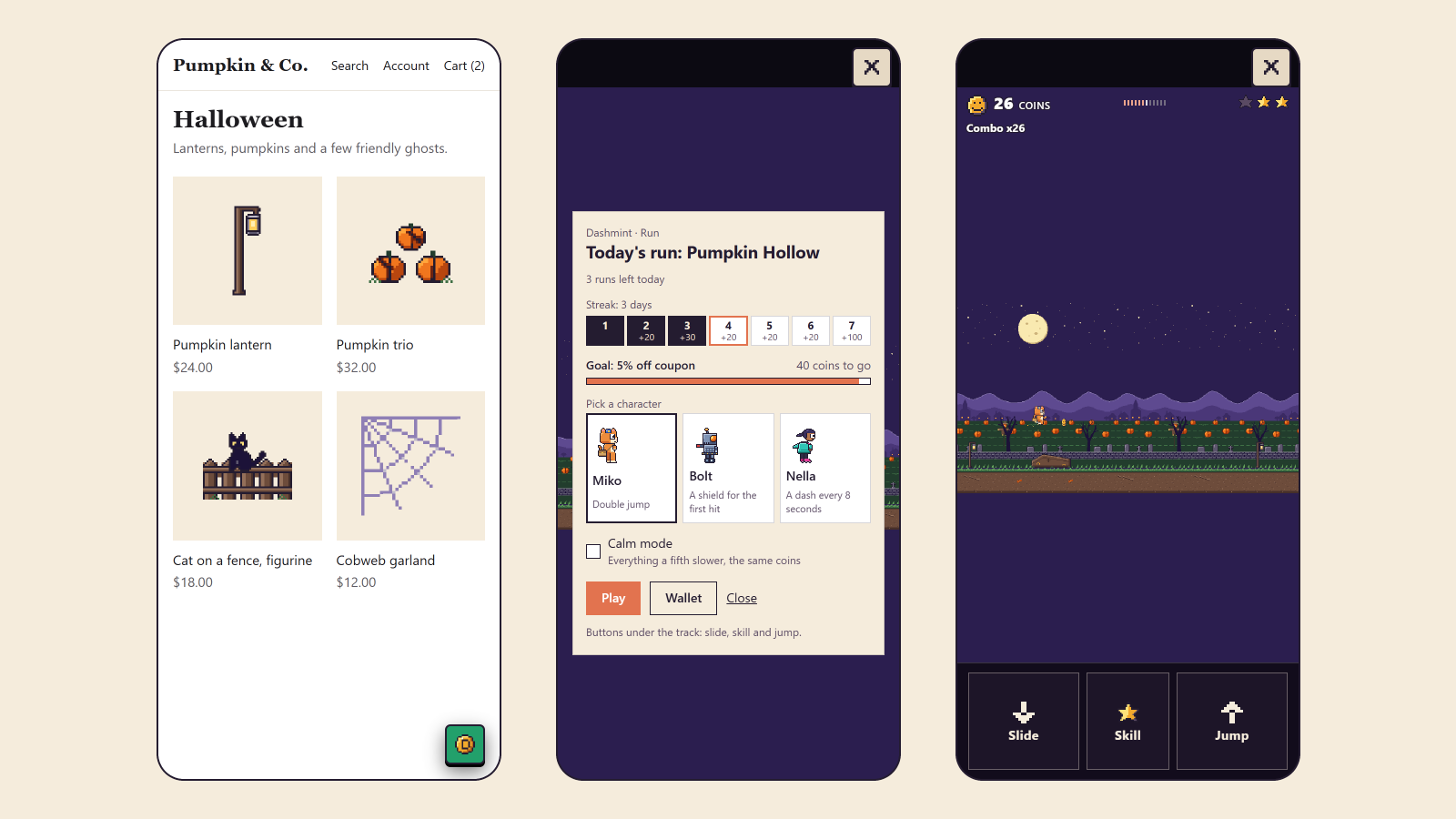
Dashmint is a 45-second pixel game on a Shopify storefront: shoppers earn coins by playing well, and turn them into discount codes the store sets.
Dashmint has been on the Shopify App Store since 8 October 2026. It installs from the listing, apps.shopify.com/dashmint, on the Free plan or with a 14-day trial of Season or Studio. The demo plays in the browser with no install and no account: open the demo. From 12 October to 8 November the map is Pumpkin Hollow.
How it works
Three steps, and the store keeps the last word on all three.
You set the rewards and the budget
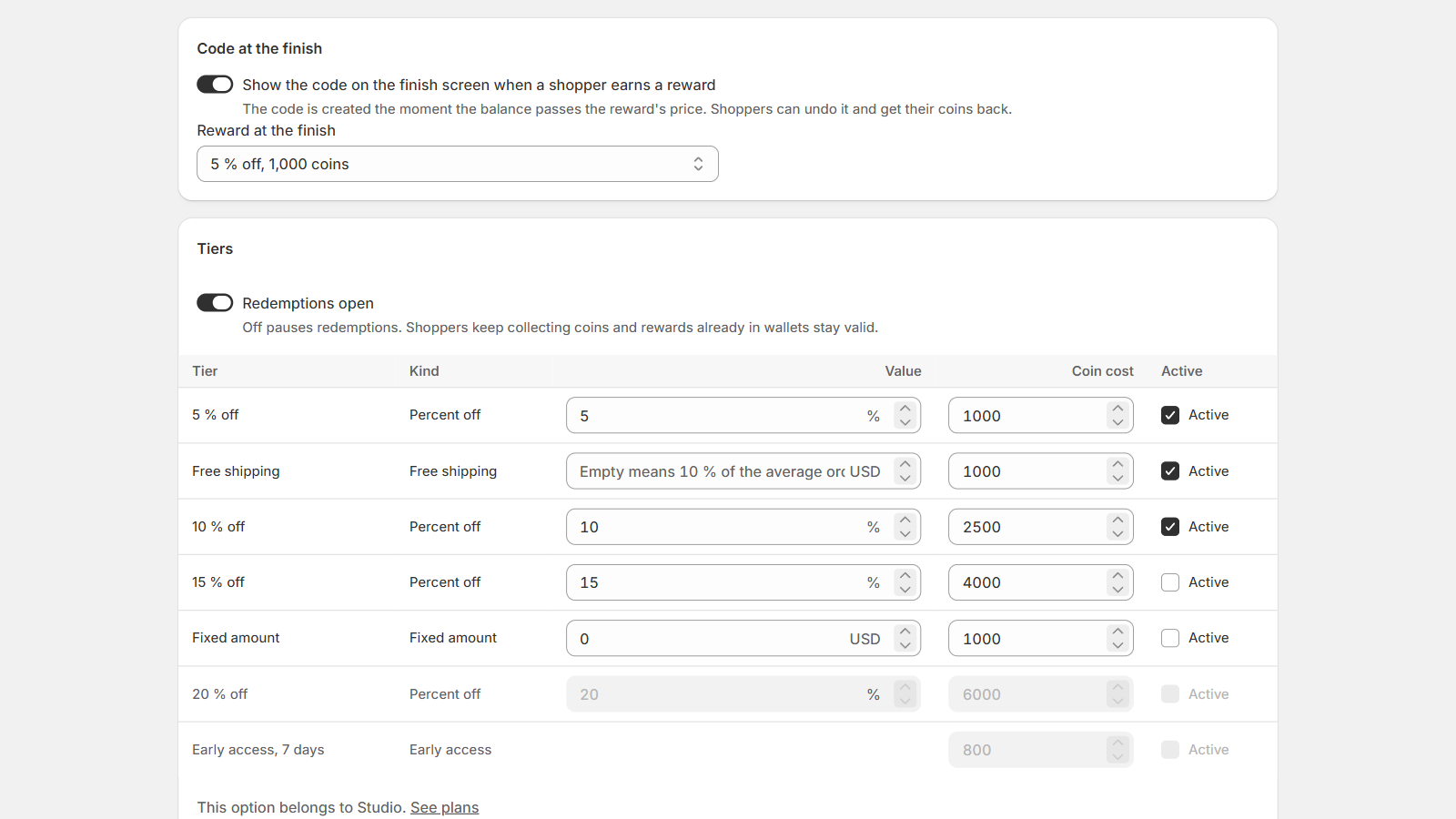
Pick a plan, pick a budget (0.25 to 3 percent of the last 30 days of revenue), and turn on the reward tiers to offer, each with its own minimum cart. On Free the reward is fixed: 5 percent off, up to 50 rewards a month.
A shopper plays 45 seconds
A tap to jump, a swipe to slide or dash. Every shopper in the store runs the same route that day, so the coins collected reflect how well someone played, not a draw.
Coins become a single-use discount code
At a reward threshold, the coins wait in a wallet. One tap in the cart turns them into a single-use code for that customer, computed from the real cart total.
What the store controls
Every run happens on the store’s own domain, inside its own theme, on settings the owner sets.
Rewards and budget
Which reward tiers are on: percent off, a fixed amount, free shipping, a free product or early access.
A monthly discount budget, set as a share of revenue, that the game will not pass.
A minimum cart and a cooldown for every tier.
Coins and quests
How many coin runs a shopper gets a day.
Whether a paid order adds coins, and how many.
The daily quests shoppers see, and on Studio, quests written by the store.
Promotions
Scheduled bonus coins, flash rewards, bonus quests and announcements.
How many run at once and how many are scheduled ahead, by plan.
Map and characters
The current seasonal map, or the evergreen map for a store that would rather skip the calendar.
Which characters are active, up to the plan’s roster size.
Widget and languages
The button’s icon, text, position and colour, set from the app, not the theme editor.
Which of the store’s languages show the game.
Custom
A store can send a brief: a scenario, a character idea, its own brand materials. I quote a game built for that store alone, with its own mascot, its own map skin and its own rules.
What shoppers get
Gestures instead of taps on fixed buttons, the way a good mobile game plays.
Gesture controls A tap to jump, holding for a higher jump, a swipe down to slide, a swipe right for a character move. Nothing is drawn over the action.
Monsters and a boss A jump on the head clears a monster and keeps the combo going. Every map ends with its own boss.
Points and a personal best Every run keeps a score and a personal best. Both are free: they cost the store nothing to show.
One route, every shopper The day’s route is the same for everyone in the store, seeded from the store and the date. What changes the result is how someone plays it.
Ten characters, each with its own move.
Miko jumps twice in the air.
Bolt shields the first hit.
Nella dashes every 8 seconds.
Grumble smashes through fragile obstacles.
Tock glides over gaps.
Luma carries a lantern that shows what is coming.
Sable keeps its combo on the first hit.
Juno pulls coins in.
Klaus rides a sleigh over obstacles for 3.5 seconds every 20 coins.
Jaga turns an obstacle into a find every 20 coins.
The map changes itself
The calendar moves the map. Nothing to deploy, nothing to remember.
Live now: Pumpkin Hollow (October 12 to November 8, 2026)
The Halloween map: lantern light, a rolling pumpkin at the finish, and a boss waiting at the end of the route.
Committed next
Neon Rush (November 9 to November 30, 2026), Christmas Lane (December 1 to December 26, 2026), Frostpeak (December 27, 2026 to January 6, 2027)
Between seasons, and on any plan that skips the calendar, the route runs on Shop Street, the evergreen map with no season attached.
A skill game, not a wheel
Most discount games on Shopify mean a wheel, a scratch card or a mystery box. Dashmint is a different category.
A skill game, not a wheel
A skill game
A wheel or scratch card
How a reward is earned
By playing today’s route. Everyone gets the same route, so the result depends on how well someone played it.
By a single spin or scratch. The odds are the same for a first visit and a regular.
Content over a year
A new map and a new rule on a published calendar.
The same graphic, reused for as long as the app runs.
What it costs as a store grows
A flat subscription and a discount budget the store sets, which the game will not pass.
Often a fee that rises with orders or traffic, or a cut of every discount redeemed.
Plans and prices
Billed through Shopify, in USD. The price is flat: nothing here changes with order count.
Free
$0
Runner mode, the current season’s map, no map choice.
Three characters: Miko, Bolt and Nella.
Three coin runs a day, one daily quest.
One reward: 5 percent off for 1000 coins.
Up to 50 rewards a month.
Shows a small Dashmint mark on the finish panel.
Season
$29 a month or $290 a year (two months free)
14-day trial
Choose Runner or Rocket mode for the store.
Choose the seasonal map or the evergreen map.
Up to six characters.
Up to four coin runs a day, three quests that can be edited.
Rewards up to 15 percent off, free shipping, a fixed amount or a product.
Coins on a paid order.
One promotion running, three scheduled.
No Dashmint mark on the finish panel.
Email support within 24 hours.
Studio
$79 a month or $790 a year
14-day trial · Recommended
Everything in Season, plus:
All ten characters, and the shopper picks the mode.
Rewards up to 20 percent off, plus an early-access reward.
Quests written by the store.
The AI promotion planner and more AI suggestions.
Three promotions running at once, ten scheduled.
Any archived seasonal map, and the next one seven days early.
The store’s own dated events, coming soon.
CSV export.
Email support within 12 hours.
Custom
Individual quote
By request
Everything in Studio.
A mascot and a map skin drawn for the store’s brand.
A game built from the store’s own brief.
Events for the store’s own dates, quoted with the brief.
Email support within 4 hours on business days.
Quoted after a brief, billed as the store’s own Shopify plan, no invoice outside Shopify.
Every plan installs from the Shopify App Store and is billed by Shopify with the store’s other charges.
Merchant questions
What comes up before a store turns the game on.
Is Dashmint a game of skill?
Yes. Every reward depends on how well someone plays. Everyone in the store runs the same route on a given day, and the server replays each run before its coins count, so the difference between shoppers is how they played.
Will it slow the store down?
The loader on the page is small, and the game itself only loads once a shopper taps to play. Nothing about the game runs on a page a shopper never opens.
Does it work with any theme?
On an Online Store 2.0 theme, one switch in the theme editor turns it on, and a “Play” block can be added to any page. On an older theme, a full-page play link works from any menu item or button already on the site.
How are the discount codes created?
Once a shopper’s coins reach a reward, it waits in their wallet. One tap in the cart turns it into a single-use code for that customer, computed from the real cart total, valid for 14 days.
Can shoppers without an account play and earn a reward?
They can always play. Redeeming a reward as a guest is off until the store turns it on: the store chooses which reward tiers a guest may redeem, how many a month, and how often per browser.
What happens to customer data?
Dashmint stores the Shopify customer ID, order IDs and amounts, short run logs and issued codes. No names, emails or addresses. IP addresses are kept as a hash after 7 days. Hosting is Google Cloud in Warsaw, and a data processing agreement is accepted at install.
What languages does it support?
Polish and English from launch, with German planned from February 2027. The store chooses which of its languages show the game.
How does a store cancel?
Through Shopify’s own billing, any time. Features run to the end of the period already paid for, then the store moves to Free automatically. Shoppers keep their coins, characters and level.
What is Custom?
A version of the game built for one store: its own mascot, its own map skin, a scenario or character the store proposes. The store sends a brief, I send a fixed quote, and it is billed through the same Shopify billing as every other plan.
How much can this cost in discounts?
The store sets a monthly discount budget as a share of the last 30 days of revenue, from 0.25 to 3 percent. The game stops issuing new rewards once active rewards would pass half that budget, and redemptions resume the following month.
Can a shopper cheat their way to a bigger reward?
The server replays every run from its own recorded inputs and ignores the score the browser reports, so a perfect run is worth the same coins however it was played.
Does the store need to build anything?
No. Turn on the embed, set a budget and the reward tiers, and the current season’s map, characters and quests are already in place.
Play first, then install.
The demo is the game a store gets, with sample rewards, in the browser and without an account. The install goes through the Shopify App Store.